
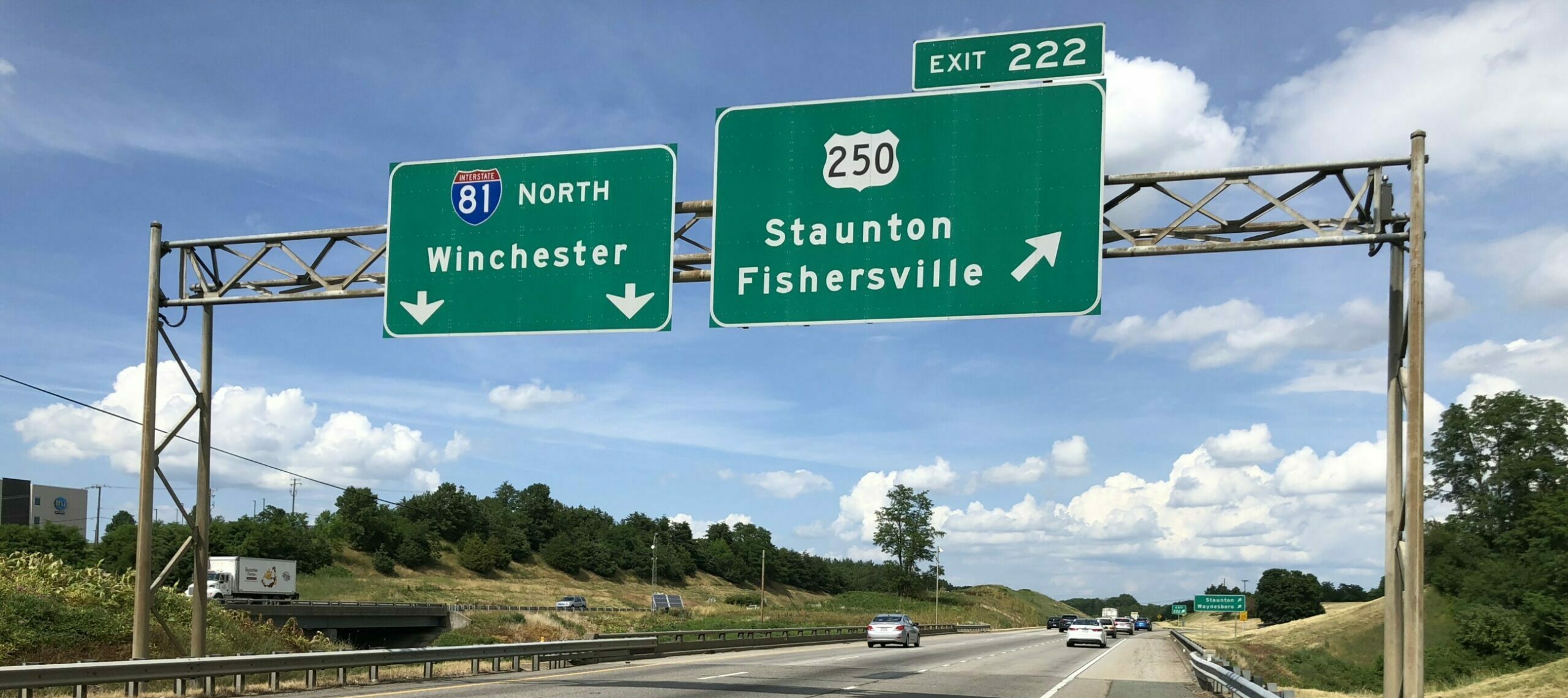
State transportation decision makers are hosting meetings this month along the I-81 corridor to gather your input on your experience on the interstate.
Upcoming I-81 Public Meetings in the Valley:
- Monday, July 14th: 5-7 PM at Blue Ridge Community College Plecker Workforce Center in Weyers Cave (directions)
- Tuesday, July 15th: 4-6 PM at Shenandoah University Brandt Student Center in Winchester (directions)
It’s important that you show up and advocate, as always, for targeted, affordable, low-impact solutions to fix data-identified trouble spots. Unfortunately, there seems to be some appetite for re-considering excessive widening of the corridor.
A Familiar Challenge: Opposing Excessive Widening
You may remember back in 2007 we opposed an expensive and destructive plan to widen the entire corridor to eight or more lanes. This plan would have been extremely detrimental to:
- neighboring agriculture,
- cultural resources, and
- small towns along the corridor.
The old plan also made improvements prohibitively expensive which meant safety and congestion issues were not addressed for years, and where they were it was with expensive, over-built projects using resources that could have supported more targeted and less expensive solutions.
The Current, Data-Driven Approach: 2018 I-81 Corridor Improvement Plan
Valley legislators and transportation planners took a new approach in 2018 when they initiated an I-81 Corridor Study. We were impressed when they came back with the current I-81 Corridor Improvement Plan which:
- used traffic data and community input to determine geographically where safety issues were frequent, and
- proposed right-sized discrete solutions.
These solutions started with things like better curve signage, on- and off- ramp extensions and the extra lanes you’re seeing constructed now through Staunton and soon in Harrisonburg.
The plan also invested in systems to notify and detour traffic and clear the road more efficiently when accidents occur. This program has achieved a 24% reduction in crash clearance time since its implementation.
The plan in total proposed 65 projects funded by a regional gas tax that was implemented in 2019. Since construction began in 2020:
- 35 projects have been completed, and
- 16 projects are currently under construction
Concerns About the Next Round of Projects
Now, planners are working to identify the next round of improvement projects. They performed a community survey in April to get input on trouble spots and have scheduled public meetings for input on proposed solutions.
Three worrisome things appear to be influencing what may be prioritized as solutions:
1. Economic Development Focus: Transportation officials are now looking at I-81 as an economic development driver and considering how they might attract heavy industry to the corridor, despite the fact that local comprehensive plans outline economic development that is complementary to our agriculture and tourism economies. This heavy industry would add more truck traffic to the already existing problem.
2. Calls for Excessive Widening: We’re hearing calls for wholesale widening of the interstate. Again, this would significantly change the character of the Valley and its small towns and farms, and it’s well documented that bigger roads induce increased traffic and higher speeds.
3. Less Incentive for Frugal Solutions: Because of the gas tax, there is a dedicated source of funding to spend in the corridor so there is less incentive to consider frugal but effective solutions.
Timing and Data Concerns
Additionally, the state’s own oversight agency cautions in a recent review of efforts to reduce congestion on I-81 that:
Re-evaluation of I-81 needs and funding should not occur for several years: wait for majority of projects in improvement program to be complete to measure impact on congestion reduction; best practice is to have 5 years of data to analyze before reliable conclusions can be made. (page 48)
According to the plan update website, the “study excludes portions of the interstate where widenings or truck-climbing lanes were recently completed or are under development.” However, the disruption of construction makes it difficult to assess future needs. We don’t yet know how these projects, when complete, will improve the corridor. Therefore the process CANNOT be data driven because the data do not exist.
Our Consistent Ask: Targeted, Economical Solutions
So, in addition to questioning the timing of this study, our ask to state transportation planners as they consider the next set of projects is the same as it was in 2018, which is the same as it was in 2007:
- Prioritize economical targeted improvements identified by safety and congestion data over excessive widening projects.
- Invest in improvements to local road networks in congested areas like Harrisonburg and Winchester, where local traffic uses I-81 instead of local roads.
What You Can Do
If you can, please attend one of the meetings this month. Let planners know where your trouble spots are and ask them to please consider targeted solutions to address specific issues.
If you can’t make the meetings, there will be an online survey open soon or you can email your input to: va81CorridorPlan@vdot.virginia.gov