Karst. It’s a funny sounding word with significant meaning for those of us living in the Shenandoah Valley. Thus, it behooves us all to learn more about karst, including what it is, why it’s important, and what it means for our water.
First, karst is the word used to describe the terrain beneath our feet. Just as some landscapes are characterized as marsh, tundra, or desert, much of ours is called karst, meaning a place filled with caves, sinkholes, springs, and outcroppings of rock, particularly limestone. The word actually comes from a region in Slovenia where this type of terrain was first described.
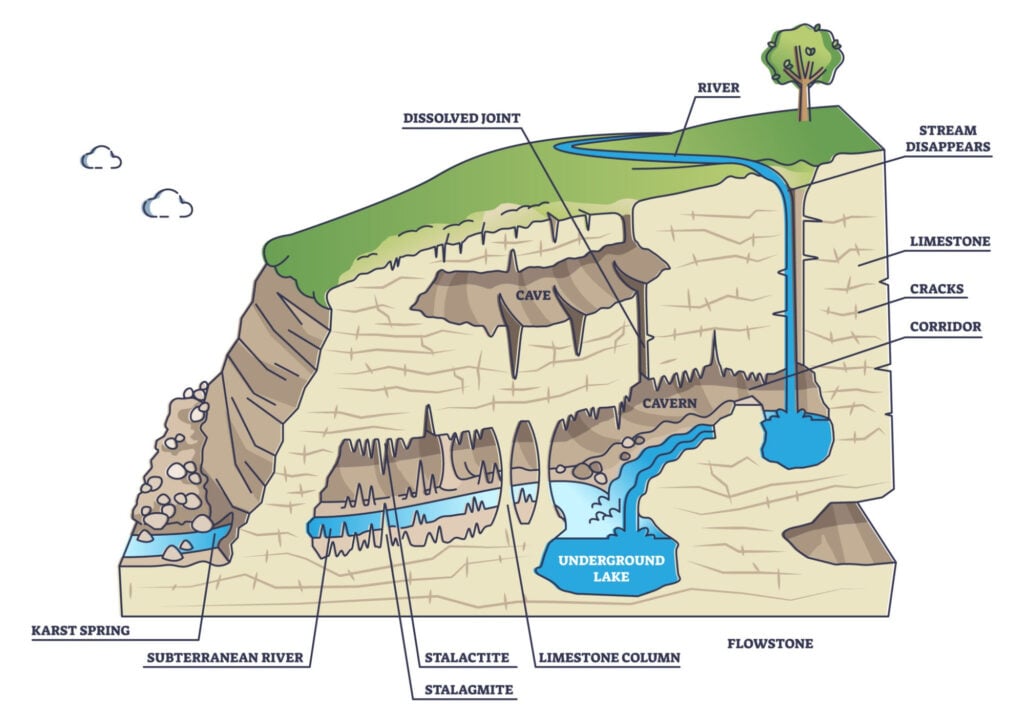
Understanding Karst: Swiss cheese beneath our feet: Diagram of a karst landscape, illustrating the underground caves, sinkholes, and fractures carved into limestone bedrock over millions of years. Illustration by VectorMine / Shutterstock.com
A karst landscape is the result of 500 million years of geologic artistry beginning when the Great Valley of Virginia was covered by an enormous tropical sea teeming with ocean creatures, many of which had hard shells. When those creatures died, they fell to the seabed and, over eons of time, their shells formed a sedimentary rock layer of calcium carbonate (limestone, dolostone, marble, and gypsum) thousands of feet thick.
Perhaps 200 million years later, a great geologic upheaval bent and folded those sandwich-like layers of rock, pushing them upward to form the Appalachian Mountains. That former seabed from those fossilized shells became our bedrock, underlying the Shenandoah Valley floor. Funny thing about that bedrock. . . turns out it is soluble, which means rainwater, which is slightly acidic, slowly dissolves the calcium carbonate remnants of those ancient sea creatures, literally eating away at the stone and belying the old saying “solid as a rock.”
The result? A karst landscape perhaps most easily described as “Swiss cheese beneath our feet,” filled with holes, cracks, caves, and fissures created by rainwater eating through rock over millions of years. Just like a porous sponge soaks up, holds, and filters water, so too does the underground “Swiss cheese” in the Shenandoah Valley. In the slow dance of geologic time, rainwater has been soaked up and stored in vast aquifers that flow through those infinite caves and fissures that intertwine beneath our feet.
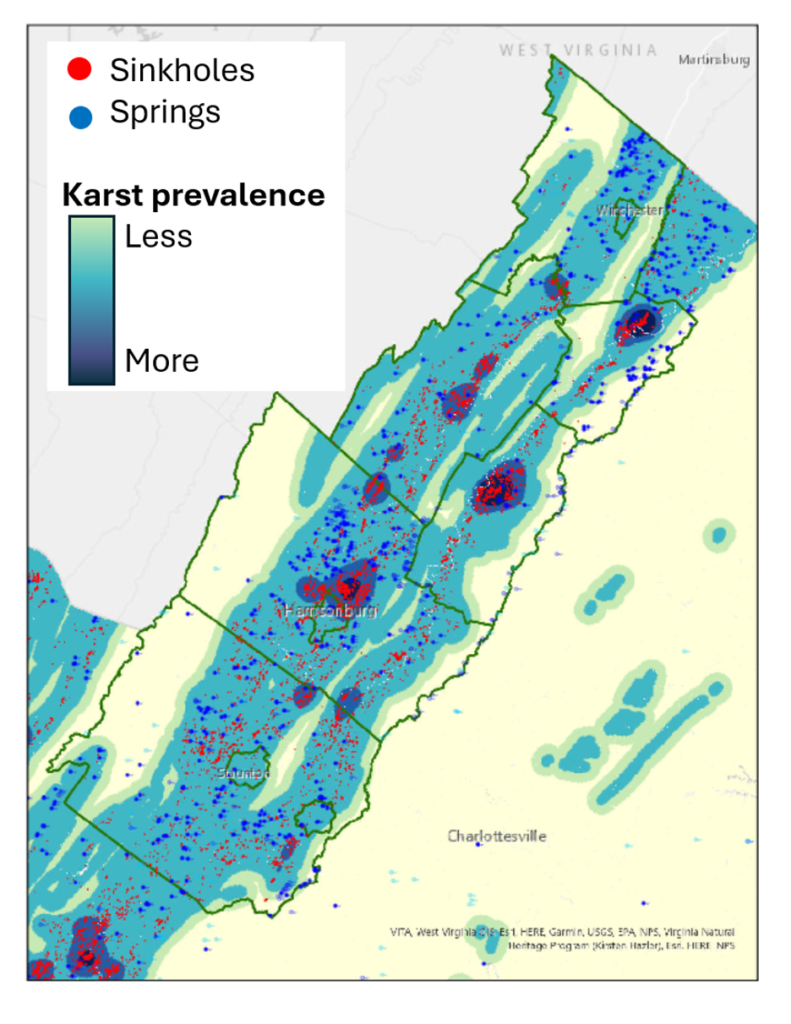
Map showing the distribution of sinkholes (red) and springs (blue) relative to karst prevalence across the region. Note the clusters near cities and towns like Harrisonburg, Luray, Front Royal, Woodstock and Strasburg.
Throughout human history in this Valley from the Native Americans until the present day residents, we have tapped those vast water resources in order to live, cultivate the land, and power industry. In fact, even though we reside in the driest region in Virginia due to a rain shadow caused by the Allegheny Mountains, we have enough water to support the two largest agricultural counties in the state. And, despite living in the driest region, our farms produce the four “Fs” of agriculture largely without irrigation (animal Feed, human Food, Fuel, and Fiber).
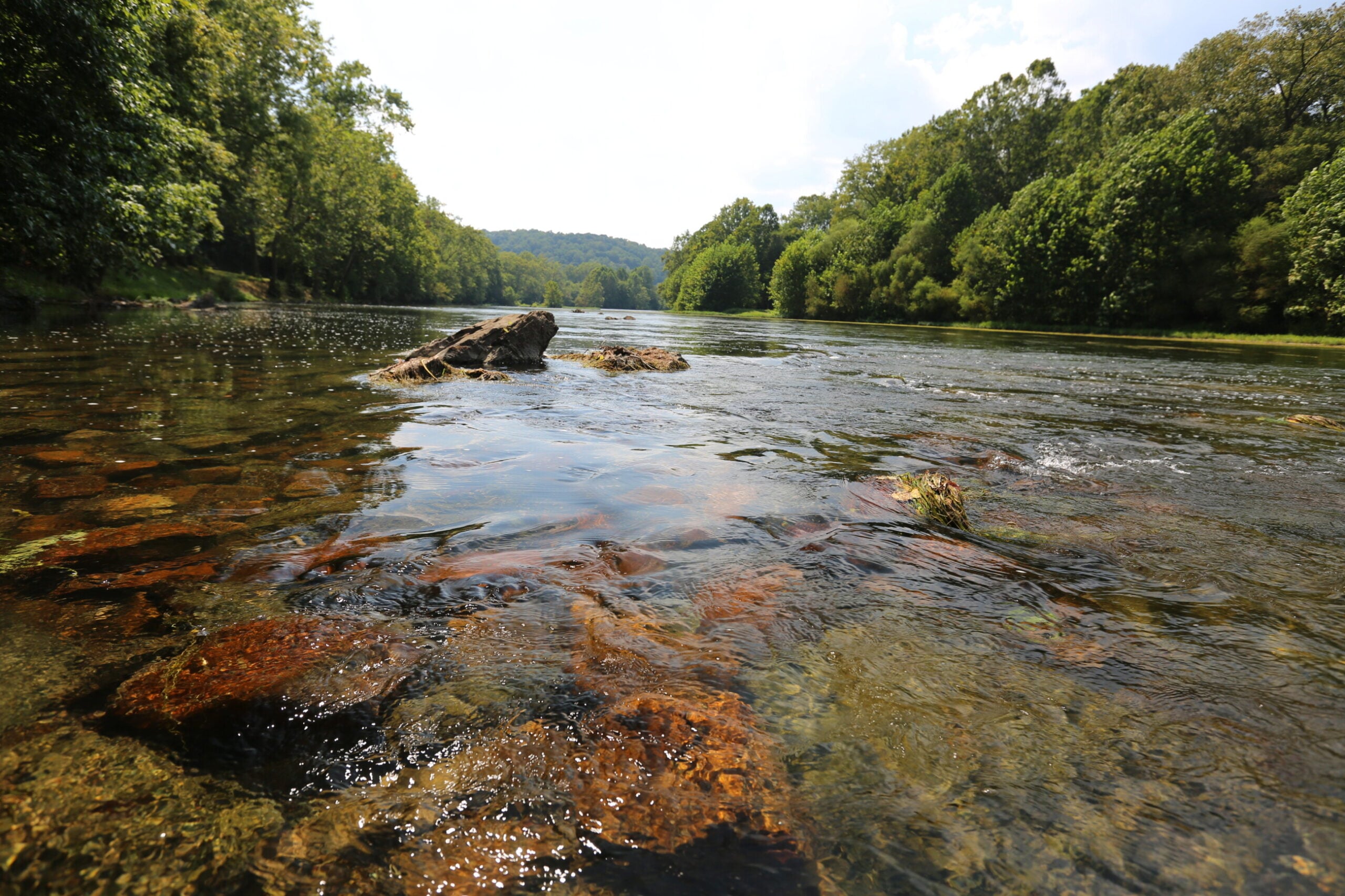
Our springs and wells spill into streams and rivers that ultimately fill the Shenandoah, Potomac and James rivers from bank to bank. From there, our water flows through the taps of both Washington, D.C., and Richmond before reaching the Chesapeake Bay, the largest estuary in the U.S. Together, prodigious springs, river water and high-yielding wells supply water to nine million people who live in the Valley and downstream. The porous sponge beneath our feet sustains the region’s agricultural and industrial economy, but without careful management, its future is far from guaranteed.
There are some who posit that karst terrain is too fragile for human habitation because of the precious water that it shields. The dangers from contamination and over-consumption created by inappropriate growth are just too great.
Because of the network of underground fissures and caves, pollution in one spot can contaminate irreplaceable water supplies miles away. And cleanup or replenishment is not easy. Studies have shown that much of the water gushing forth from the Valley’s wells and springs did not come from yesterday’s thunderstorm or even last winter’s snowstorm. Indeed, some of the water is actually hundreds of years old and has been sitting underground since before European settlement.
Living on top of such a powerful and fragile resource is a huge responsibility. Mistakes made now will affect generations to come. That is why we work so hard to affect local land-use policy that guides where development happens. Our vision for a future Shenandoah Valley “sustained by farms and forests, clean streams and rivers, and thriving communities” is not possible without the clean and abundant water beneath our feet. And we are making progress…one drop at a time.
Nancy Sorrells wears many hats in the community. In addition to Senior Community Advisor for the Alliance, she is a former Augusta County Supervisor, founding member of Fields of Gold agritourism initiative, freelance writer and Valley historian.