
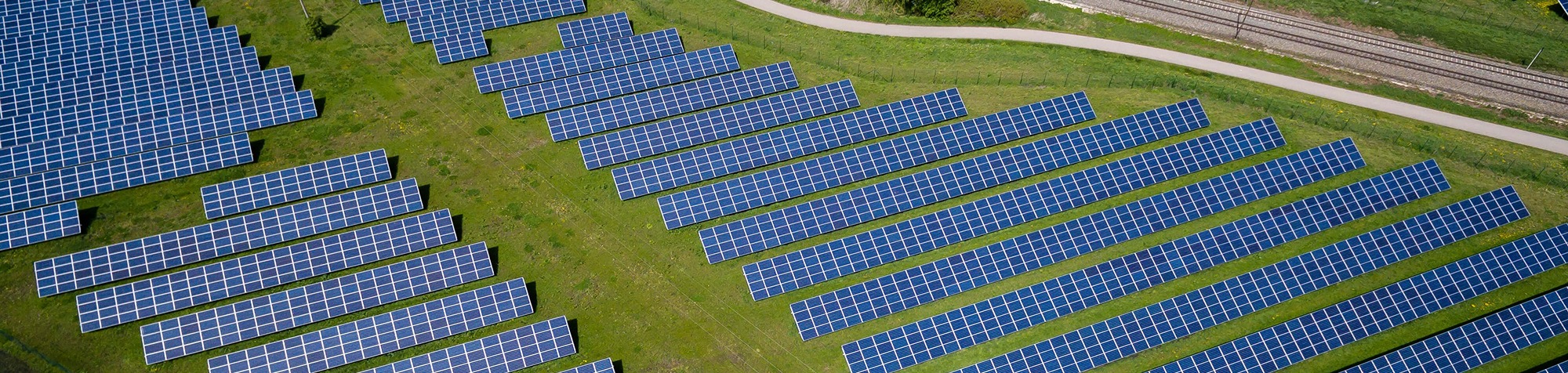
With increasing demand for renewable energy, we are seeing proposals for utility-scale solar developments in most of the localities in the Shenandoah Valley. Since 2019, Alliance staff and board have been working to get it right with solar in the Valley—we envision solar development that complements, not conflicts with, our agriculture and forestry economy.
Utility Scale Solar
The Alliance believes scaling up renewable energy can be a significant positive step statewide if properly implemented and can bring economic opportunities for businesses and landowners. Utility-scale proposals are more likely to be successful if they are thoughtfully designed and localities are prepared to thoroughly evaluate and consider the positive and negative impacts in their community.
There are two types of solar energy developments. Utility or large-scale solar generates power to be sold to a utility and fed into the power grid. Distributed solar is used on-site, such as for a business, farm or home. This latter type of solar installation helps meet localized demand and does not require major transmission upgrades.
The Alliance recommends proposals be designed to:
Effective erosion control and stormwater management during construction and during the life of the project is key to protecting groundwater and local streams.
Here in the Valley, we have some of the finest agricultural soils in the nation. When it’s not feasible for a solar installation to avoid prime agricultural soils, grading, compression and soil disturbance should be minimized so that a site can be used for farming again in the future.
In the wrong location, utility-scale solar installations could run counter to a locality’s pursuit of historic resource protection and tourism associated with historic and scenic assets.
Effective decommissioning provisions should be included in all utility-scale solar projects, ensuring that the land can be used for productive agriculture or other use after the life of the contract (generally 25-30 years).
Will a solar project require new or upgraded transmission lines or substations? The impacts of the new infrastructure should be assessed along with the impacts of the solar project. Local ordinances and comprehensive plans should also be consulted in order to ensure compatible development that is right for each community.
Some utility-scale solar projects allow for continued grazing (generally sheep) or hay in conjunction with the installation, and others use native or pollinator plants, contributing to the farm economy and minimizing the need for extensive herbicide application.
Resources
- Virginia Conservation Network – 2024 Briefing Book Utility Scale Solar (Published 2023)
- Rappahannock River Basin Commission – Stakeholder Perspectives on Utility-Scale Solar Facility Development and Key Considerations for Decision Makers (June 2023)
- Great Plains Institute – Best Practices: Photovoltaic Stormwater Management Research and Testing (Jan 2023)
- ICMA/APA – Solar@Scale: A Local Government Guidebook for Improving Large-Scale Solar Development Outcomes (Dec 2022)
- UVA Energy Transition Initiative – Decommissioning Utility-Scale Solar Facilities (August 2022)
- Alliance for the Shenandoah Valley – Incorporating Solar into Agricultural Landscapes: Workshop for Farmers (Feb 2022)
- Southern Environmental Law Center – Solar Initiative Solar Policy Brief (March 2017)
- NC Clean Energy Technology Center
- Piedmont Environmental Council (PEC) Research on Data Center and Energy Demand
Related News
Augusta Solar Getting it Right
May 10, 2024
This project checks all the boxes for a good solar project and is in accord with Augusta County’s comp plan.
Ask Augusta to delay Solar Ordinance changes
Nov 09, 2023
It makes no sense to change an ordinance that is working and follows the comp plan to something that does not match the comp plan and might or might not match the pending citizen input regarding solar development within Augusta.
Beyond Solar Ordinances: Utility Scale Solar Policy, Host Siting Agreements & Other Emerging Topics
Oct 05, 2023
Attendees will learn about solar installation options and how solar can fit and complement existing agricultural operations.
Shining Light on Two Augusta Solar Projects
Oct 02, 2023
Two projects in Augusta County that the Alliance can get behind and hope that Augusta residents, too, can support.
Shenvalee Solar Project
Sep 06, 2023
We know that solar is part of the transition to renewable energy, and, done right, it can be compatible with and even complement our agricultural region.
Solarize Virginia Information Sessions 2023
Jul 27, 2023
If you’ve been considering solar, Solarize Shenandoah is a one-stop-shop to find out how you can incorporate solar on your property.
Getting it right with solar
Jun 27, 2023
With the right local and state guidelines in place, we hope to see solar projects in the Shenandoah Valley that minimize negative impact and even benefit local communities.
Solar Figures into the Future of Mount Jackson Farm
Jun 15, 2023
When Fred Garber surveys the progress of the new solar installation on his family farm in Mount Jackson, he sees the future. And that gives the nearly 79-year-old a tiny bit of peace.
Two Augusta solar projects to support
May 31, 2023
We know that solar is part of the transition to renewable energy, and, done right, it can be compatible with and even complement our agricultural region.
Shenandoah Solar Ordinance Approved
May 08, 2023
We applaud Shenandoah County for approving a solar ordinance that successfully balances protection of agricultural lands while allowing opportunity for new energy development.